

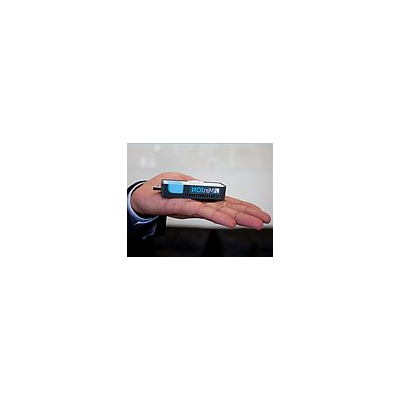
Fünftausend Basenpaare umfasst die DNA des Phi-X-Virus. Schon aus historischer Sicht war dieser das geeignetste Versuchsmaterial für den Sequenzer-Stick, der von Nanopore vergangenen Freitag auf der Fachtagung „Advances in Genome Biology and Technology” in Florida präsentiert wurde. Denn das Erbmaterial des Virus ist das erste, das je vollständig entschlüsselt wurde. Ein Prozess, der von MinION in wenigen Sekunden abgewickelt wurde.
Ähnlich flott verspricht das Gerät auch bei anderen, eher simplen Lebewesen – wie anderen Viren und Bakterien – zu arbeiten. Doch auch mit umfangreicheren Genomen soll er umgehen können, brauchtdafür jedoch entsprechend länger.
Enzym spaltet Erbgut auf
Zum Auslesen wird die jeweilige DNA in einer Lösung platziert. Darin befindliche Enzyme binden sich an die Enden der beiden Stränge. Durch das Zuführen von Spannung sammeln sich die Enzyme und die Genomstränge in kleinen, gerade einmal zehn Mikrometer dünner „Brunnen” am Boden der Flüssigkeit.
In diesen Löchern befindet sich jeweils eine modifizierte Version des Alpha-Hämolysin-Proteins (AHL). Die an die DNA-Ketten angebundenen Enzyme hängen sich an dieses an und beginnen in Folge, das Erbgut aufzuspalten und jeweils eine Kette in ein rohrförmiges Loch im AHL zu schleusen. Dies erzeugt bei jeder einzelnen Base eine unterschiedliche Spannungsvarianz. Diese wird von MinION erfasst und der Reihe nach ausgelesen, bis der Strang vollständig dekodiert ist.
Nanopore arbeitet nun an einer leistungsfähigeren, größeren Ausgabe des Geräts. Dieses trägt den Namen GridION und soll den Prozess noch schneller abwickeln und größere Genome verarbeiten können. Das derzeitige Limit liegt bei 10.000 Basenpaaren.
Marktstart noch 2012
Die Arbeitsweise des wissenschaftlichen Gadgets bietet zwei große Vorteile im Vergleich zu üblichen Verfahren. So kann MinION die Stränge auf einmal verarbeiten, während sie sonst in kleinere Fragmente von wenigen hundert Basen aufgespalten und danach wieder zusammengesetzt werden müssen. Zudem ist keine Amplifizierung der DNA notwendig. Dabei hanelt es sich um einen langwieriger Prozess der Genom-Vermehrung, der sonst Voraussetzung für ein zuverlässiges Auslesen ist.
MinION soll im Laufe des Jahres auf den Markt kommen und wird voraussichtlich 900 Dollar (aktuell rund 680 Euro) kosten. Die Entschlüsselung des menschlichen Erbguts soll damit schätzungsweise sechs Stunden in Anspruch nehmen. „Sollten sich Kosten, Qualität, Einfachheit der Handhabung und der Output in Einklang mit den anderen Geräten im Labor bringen lassen, könnte das eine Killer-Technolgie sein”, urteilt Nick Loman, Bioinformatiker der University of Cambdridge, gegenüber New Scientist.
Auf dem jungen Markt der „Desktop Sequencer” tut sich aber bereits Konkurrenz auf. So hat das Unternehmen 454 Life Sciences ein ähnliches Gerät angekündigt, das für einen um 100 Dollar höheren Preis nur zwei Stunden für die Dekodierung menschlicher DNA benötigen soll.
Oxford Nanopore introduces DNA ‘strand sequencing’ on the high-throughput GridION platform and presents MinION, a sequencer the size of a USB memory stick
At the Advances in Genome Biology and Technology conference (AGBT), FL, US, Oxford Nanopore presented:
- A novel method of DNA ‘strand sequencing’ that uses an array of proprietary protein nanopores embedded in a robust polymer membrane. Each nanopore sequences multiple strands of DNA from solution in succession, as individual strands are passed through the nanopore by a proprietary processive enzyme. Base calling is performed by identifying characteristic electronic signals (disruptions in current through the nanopore), created by unique combinations of DNA bases as they pass through a specially engineered region inside the nanopore.DNA and enzyme are mixed in solution, engage with the nanopore for sequencing and once the strand has been completed a new strand is loaded into the nanopore for sequencing.
- Genomes that have been sequenced as contiguous reads comprising both complementary strands of the entire genome. An example was shown of lamda, a 48kb genome, sequenced as complete fragments, whose sense and antisense strand total 100 kilobases. Read lengths mirror fragment sizes in the sample with no exponential loss of processivity.
- Accuracy levels competitive with existing market-leading systems were shown. No deterioration of accuracy is seen throughout the sequencing of individual strands. A development pathway was presented that is expected to achieve accuracy exceeding current market-leading platforms through further design iteration of Oxford Nanopore’s custom-made nanopores.
- Oxford Nanopore’s GridION platform was presented, consisting of a scalable network device – a node – designed for use with a consumable cartridge. Each cartridge is initially designed for real-time sequencing by 2,000 individual nanopores at any one time. Alternative configurations with more processing cores will become available in early 2013 containing over 8,000 nanopores.
- Nodes may be clustered in a similar way to computing devices, allowing users to increase the number of nanopore experiments being conducted at any one time if a faster time-to-result is required. For example, a 20-node installation using an 8,000 nanopore configuration would be expected to deliver a complete human genome in 15 minutes.
- A variety of sample preparation options were presented. No sample amplification is required and any user-derived sample preparation resulting in double stranded DNA (dsDNA) in solution is compatible with the system. With nanopores embedded in robust polymer membranes, dsDNA can be sensed directly from blood and in some cases with no sample preparation.
- Oxford Nanopore’s disruptive „Run Until…” informatics workflow: Nanopores allow the analysis of data in real time, as the experiment happens. Each GridION node contains all the computing hardware and control software required for primary analysis of data as it is streamed from each nanopore, resulting in full length real-time delivery of complete reads so that the user can perform secondary analyses as the experiment progresses. This allows the user to pre-determine an experimental question and continue the sequencing experiment until sufficient data have been accumulated to answer the question and move on to the next experiment.
- Oxford Nanopore intends to introduce a new pricing model for its GridION sequencing system, which moves away from the traditional instrument price and consumable price. This is designed as a series of packages that allow the user to tailor a scheme to their budget structure, whether more flexible with capital or consumable expenditure. Transparent pricing schemes are designed for online ordering and fulfilment, with discounts applying to larger packages. Overall the schemes are designed to deliver a competitive ‘price per base’ compared to other systems on the market based on like-for-like user settings.
